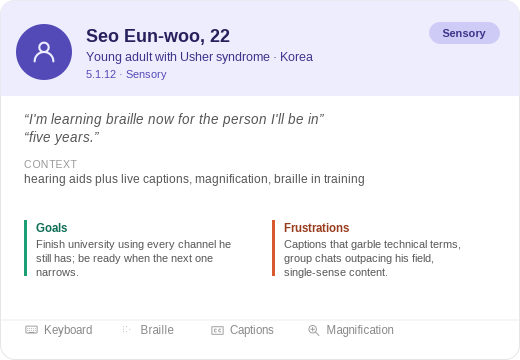
서은우 · Seo Eun-woo
Young adult with Usher syndrome
Korea · East Asia (Korea) · Age 22
- Law
- 장차법 · KWCAG 2.2
- Services
- 정부24 / 카카오·토스
- Messaging
- KakaoTalk
Assistive Technology
- Keyboard
- Braille
- Captions
- Magnification
I'm learning braille now for the person I'll be in five years.
Goals
Finish university using every channel he still has; be ready when the next one narrows.
Frustrations
Captions that garble technical terms, group chats outpacing his field, single-sense content.
Profile
Seo Eun-woo is a university student with Usher syndrome. This rare genetic condition combines congenital hearing loss with progressive vision loss from retinitis pigmentosa (RP). She still has residual sight and hearing, but both are gradually declining, so she is learning braille and touch-based technology.
Technology Environment
- Hearing support: hearing aids + captioning service
- Vision support: screen magnifier + refreshable braille display (learning)
- Communication: text-based messaging; sign language + captions on video calls
- Learning: tactile keyboard markers, vibration alerts
Daily Scenario
Tuesday morning's lecture, Eun-woo sits in the front row, reading the professor's lips and combining that with the sound through her hearing aids to follow along. At the same time she watches a live-captioning service on her tablet, but technical terms are often misrecognized, which is confusing.
// Eun-woo's multimodal learning setup
Learning channels:
1. Visual (using residual sight)
   - Magnification: 3–4×
   - High-contrast mode: black text on white
   - Large font: at least 20pt

2. Auditory (hearing aids + tech support)
   - Live captioning (CART)
   - FM system connection
   - Noise reduction

3. Tactile (preparing for the future)
   - Braille learning app
   - Vibration feedback
   - Tactile graphic display (experimental)
At lunch, Eun-woo chats with friends by messenger. Her field of vision has narrowed recently, so following a conversation on a small phone screen is hard—especially in group chats, where fast-arriving messages slip past her.
In the evening, Eun-woo takes a braille class at a disability support center. She's still slow, but she practices hard, preparing for when her sight worsens further. She's also learning to read digital documents with a refreshable braille display.
Challenges & Strategies
- Dual sensory loss: she receives both visual and auditory information only partially. Eun-woo uses every sensory channel she can and takes information in redundantly.
- Progressive condition: her state keeps changing, so she has to keep adapting. She learns a range of assistive technologies in advance for the future.
- Communication barriers: face-to-face communication is especially hard. She flexibly uses sign language, written notes, and text interpreting depending on the situation.
Design Implications
- Multimodal interface: provide visual, auditory, and tactile information.
- Adaptive UI: adjustable to a user's changing abilities.
- Redundant information: deliver important information through multiple senses.
- Compatibility: smooth interoperability with a range of assistive technologies.