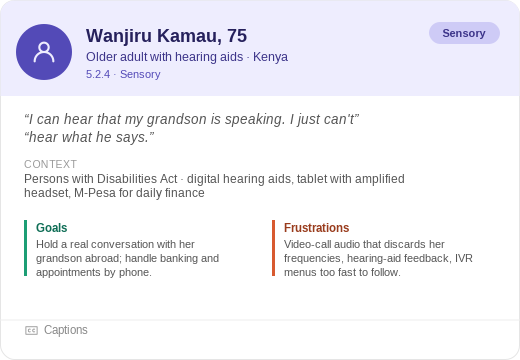
Wanjiru Kamau
Older adult with hearing aids
Kenya · Africa · Age 75
- Law
- Persons with Disabilities Act 2003
- Services
- eCitizen / M-Pesa
- Messaging
Assistive Technology
- Captions
I can hear that my grandson is speaking. I just can't hear what he says.
Goals
Hold a real conversation with her grandson abroad; handle banking and appointments by phone.
Frustrations
Video-call audio that discards her frequencies, hearing-aid feedback, IVR menus too fast to follow.
Profile
Wanjiru Kamau wears hearing aids in both ears for age-related hearing loss. Her high-frequency loss is severe, so consonants are hard to distinguish, and women's and children's voices are especially difficult. She tries to stay in touch with family through digital devices but struggles with sound quality.
Technology Environment
- Hearing aids: digital, with Bluetooth she finds hard to learn
- Communication: large-screen tablet, volume-amplified headset
- TV: connected to a wireless hearing-aid transmitter
- Phone: considering a captioned telephone
Daily Scenario
Sunday morning, Wanjiru video-calls her grandchild abroad. The child's high voice sounds metallic, and an unstable connection keeps cutting out. She turns the volume to maximum, but that only makes the feedback whine louder.
"Grandma, can you hear me?" the child asks, but Wanjiru can only guess from the lips. She holds the tablet near her ear and adjusts the hearing-aid volume, with no improvement. In the end her daughter-in-law interprets loudly beside her.
// The video-call difficulties Wanjiru faces
Problems:
1. Degraded sound quality
   - High-frequency loss from internet compression
   - Acoustic limits of a small speaker
   - Echo and delay

2. Hearing-aid interference
   - Electromagnetic interference from devices
   - Feedback (whine)
   - Complicated Bluetooth pairing

3. Audio-visual mismatch
   - Out-of-sync video and audio
   - Small screen makes lip-reading hard
   - Confusion when several people talk at once

Attempts:
   - Wired headphones → conflict with hearing aids
   - Speakerphone mode → worse feedback
   - Captions → poor language support
In the afternoon Wanjiru phones to make a hospital appointment. The automated system's voice is too fast to follow. She misses "Press 1 to book, press 2 for test results…" and has to listen from the start again. In the end she asks her daughter to book for her.
Challenges & Strategies
- Complex acoustic environments: when sounds mix, she can't separate them. Wanjiru creates a quiet setting and asks for one person to speak at a time.
- Difficulty using the technology: she can't fully use her hearing aids' many features. She sticks to the basic settings and has given up on the complex ones.
- Fatigue and stress: concentrating to hear tires her quickly. She holds important conversations in the morning and rests often.
Design Implications
- Voice optimization: emphasize low frequencies, slower pace, clear articulation.
- Visual support: large captions, visual cues, lip-reading emphasis.
- Simple interface: usable right away without complex settings.
- Noise reduction: minimize background sound, enhance speech.