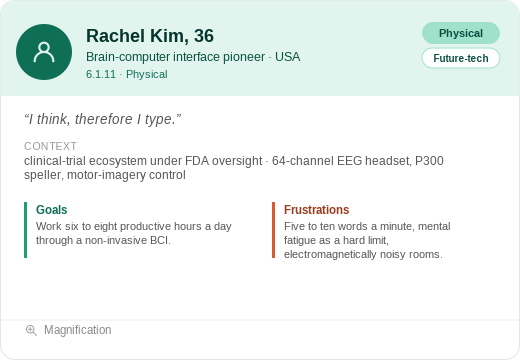
Rachel Kim
Brain-computer interface pioneer
USA · North America · Age 36
- Law
- ADA · Section 508
- Services
- Login.gov / state portals
- Messaging
- iMessage · WhatsApp
Assistive Technology
- Magnification
I think, therefore I type.
Goals
Work six to eight productive hours a day through a non-invasive BCI.
Frustrations
Five to ten words a minute, mental fatigue as a hard limit, electromagnetically noisy rooms.
Profile
Rachel Kim became quadriplegic in a car accident five years ago, but as an early adopter of the latest brain-computer interface (BCI) technology she communicates with the digital world by thought alone. Drawing on her past career as a software engineer, she also helps develop BCI software. A non-invasive BCI headset lets her work 6–8 hours a day.
Technology Environment
- BCI system: 64-channel EEG headset, real-time signal processing
- Feedback: visual brainwave patterns, auditory confirmation tones
- Control: P300 speller, motor imagery, concentration modulation
- Integrated control: smart home, computer, powered wheelchair
Daily Scenario
At 9 a.m. Rachel puts on the BCI headset. A caregiver helps position the electrodes precisely and check impedance. Calibration begins: letters flash randomly on screen as she focuses on a target, and the system learns her unique brainwave pattern.
She needs to write an email. The P300 speller works: letters are laid out in a 6×6 grid, with rows and columns flashing in turn. To enter 'H,' Rachel produces a specific brainwave (the P300) when the row and the column containing 'H' flash.
# Rachel's BCI system configuration
class BCISystem:
    def __init__(self):
        self.channels = 64
        self.sampling_rate = 1000  # Hz
        self.paradigms = {
            'P300_speller': {
                'grid_size': (6, 6),
                'flash_duration': 100,          # ms
                'inter_stimulus_interval': 175, # ms
                'repetitions': 15,              # repeats to improve accuracy
                'accuracy': 0.92
            },
            'motor_imagery': {
                'classes': ['left_hand', 'right_hand', 'feet', 'tongue'],
                'commands': {
                    'left_hand': 'cursor_left',
                    'right_hand': 'cursor_right',
                    'feet': 'click',
                    'tongue': 'back'
                },
                'accuracy': 0.85
            },
            'concentration_control': {
                'threshold_low': 0.3,
                'threshold_high': 0.7,
                'applications': {
                    'scroll_speed': 'concentration_level * 100',
                    'zoom_level': 'concentration_level * 5'
                }
            }
        }

    def adaptive_learning(self):
        """Adapt to changes in the user's brainwave patterns."""
        return {
            'daily_calibration': '10 min',
            'continuous_adaptation': True,
            'fatigue_detection': True,
            'personalized_models': True
        }
In the afternoon, Rachel codes. Text entry is still slow, but cursor control via motor imagery has become quite fluent—imagining a left-hand movement steers the cursor left, a right-hand movement steers it right, and imagining stamping a foot clicks.
In the evening, Rachel joins an online BCI users' group and shares her experience on a video call: "At first writing one sentence a day was hard. Now I can enter up to 40 words an hour. Slow, but being able to express my thoughts feels like a miracle." When fatigue rises, the BCI's accuracy drops; the system detects it and warns her, and she takes a short rest, running a meditation app until her brainwaves settle.
Challenges & Strategies
- Slow input: a P300 speller tops out around 5–10 words per minute. Rachel combines predictive text, macros, and speech recognition.
- Mental fatigue: the high concentration required tires her quickly. She works in short sessions with ample rest.
- Environmental interference: ambient noise, light, and electromagnetic fields affect the signal. She works in a shielded space and uses noise-cancelling algorithms.
Design Implications
- BCI-optimized UI: optimize flash frequency, contrast, and size.
- Hybrid input: seamless switching between BCI and other input methods.
- Fatigue management: analyze usage patterns, suggest breaks.
- Personalization: continuous learning matched to each user's brainwave pattern.