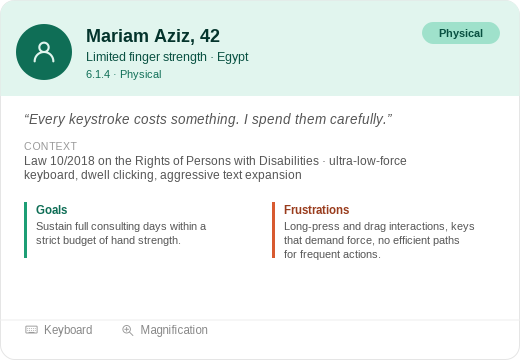
Mariam Aziz
Limited finger strength
Egypt · MENA · Age 42
- Law
- Law 10/2018 on the Rights of PWD
- Services
- Digital Egypt
- Messaging
Assistive Technology
- Keyboard
- Magnification
Every keystroke costs something. I spend them carefully.
Goals
Sustain full consulting days within a strict budget of hand strength.
Frustrations
Long-press and drag interactions, keys that demand force, no efficient paths for frequent actions.
Profile
Mariam Aziz has a progressive muscular disease, leaving her grip and finger pressure very weak. She works as a marketing consultant and has to use a computer all day, but even an ordinary keyboard's key force is taxing. She constantly researches ways to get maximum efficiency from minimal force.
Technology Environment
- Keyboard: ultra-low-force membrane keyboard (actuation under 25g)
- Pointing: touchpad, lightweight stylus
- Aids: compression gloves, wrist rest
- Software: auto-click, hover-click features
Daily Scenario
At 9 a.m. Mariam starts working from home. First she stretches her fingers and puts on compression gloves. Checking email takes a lot of typing, and her fingers tire quickly over long sentences.
Mariam relies heavily on text expansion. Typing "ty" expands to "thank you," and "pfa" to "please find attached." She has saved all her frequent phrases as shortcuts.
// Mariam's accessibility profile
const lowForceAccessibility = {
  keyboard: {
    keyRepeatDelay: 2000,   // 2s (very long)
    keyRepeatRate: 40,      // slow repeat
    stickyKeys: true,       // hold modifiers without pressure
    filterKeys: true,       // ignore rapid repeats
    virtualKeyboard: {
      keyPressDelay: 0,         // instant
      hapticFeedback: 'light',
      soundFeedback: true,
      predictiveText: 'aggressive'
    }
  },
  pointer: {
    clickMethod: 'tap-to-click',
    dragMethod: 'tap-and-drag',
    dwellClick: { enabled: true, delay: 1500, showTimer: true },
    gestures: {
      twoFingerTap: 'right-click',
      threeFingerTap: 'middle-click',
      pinchZoom: 'disabled',   // disable strenuous gestures
      rotate: 'disabled'
    }
  },
  voiceInput: {
    activationMethod: 'always-listening',
    confirmationBeep: true,
    showTranscript: true
  }
};
Working on a presentation in the afternoon, Mariam finds precise object selection with the mouse hard. Dragging means holding the button down, which her weak grip often loses. Instead she uses 'click lock': one click latches the mouse button down, another releases it.
Days with video calls are especially hard. Using the laptop trackpad for long hurts her fingers. Mariam connects an external touchpad and works with light touches over a wider area. Frequent functions like screen share and mute she's set to keyboard shortcuts.
Challenges & Strategies
- Difficulty sustaining pressure: long-press and drag are nearly impossible. Mariam uses settings that replace everything with a tap.
- Fine manipulation: small buttons and sliders are hard. She uses magnification and a large pointer, and prefers keyboard navigation.
- Cumulative fatigue: even short tasks build fatigue fast. She rests often and reduces typing with voice input.
Design Implications
- Light-touch recognition: interfaces that work with minimal pressure.
- Alternative interactions: toggle instead of long-press, tap-tap instead of drag.
- Efficient input: autocomplete, templates, quick access to frequent items.
- Fatigue-reducing design: minimize repetitive actions, offer batch operations.