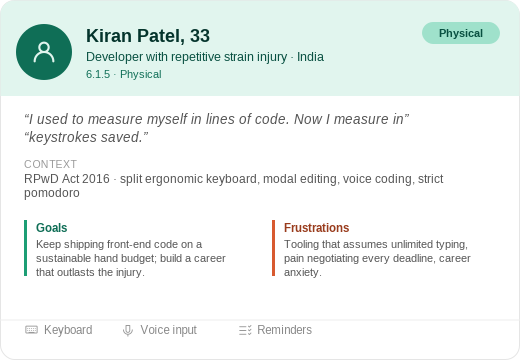
Kiran Patel
Developer with repetitive strain injury
India · South Asia · Age 33
- Law
- RPwD Act 2016
- Services
- Aadhaar / UMANG / UPI
- Messaging
Assistive Technology
- Keyboard
- Voice input
- Reminders
I used to measure myself in lines of code. Now I measure in keystrokes saved.
Goals
Keep shipping front-end code on a sustainable hand budget; build a career that outlasts the injury.
Frustrations
Tooling that assumes unlimited typing, pain negotiating every deadline, career anxiety.
Profile
Kiran Patel has worked as a front-end developer for eight years and, for the past three, has struggled with carpal tunnel syndrome and tendinitis. He was a workaholic who coded ten-plus hours a day, but now he is finding a sustainable way to develop alongside pain management.
Technology Environment
- Keyboard: split ergonomic keyboard (Kinesis Advantage)
- Mouse alternatives: vertical mouse, trackball, pen tablet in rotation
- Dev environment: Vim with voice commands, code-snippet expansion
- Aids: wrist braces, standing desk, timer app
Daily Scenario
After the morning standup, Kiran reviews the React component he needs to build today. He used to dive straight into code; now he first writes pseudocode on paper—a planning step to reduce the amount of typing.
" Kiran's RSI-friendly Vim config
" maximum efficiency from minimal keystrokes

" leader on the spacebar (uses the thumb)
let mapleader = " "

" frequent commands as shortcuts
nnoremap <leader>s :w<CR>
nnoremap <leader>q :q<CR>
nnoremap <leader>x :x<CR>

" code-snippet shortcuts
inoremap ;rc import React from 'react'<CR>
inoremap ;us const [, set] = useState()<Esc>F[a
inoremap ;ue useEffect(() => {<CR>}, [])<Esc>O

" voice-command integration (Dragon NaturallySpeaking)
" "create component" -> generate component template
" "add state"        -> add a useState hook

" macros for repetitive actions
" qa -> start recording, q -> stop, @a -> run, @@ -> repeat last
When coding begins, a 25-minute timer runs. Kiran keeps to the Pomodoro technique strictly. When it rings he lifts his hands off the keyboard immediately and stretches for five minutes—wrist rolls, finger extensions, shoulder exercises, without skipping.
In the afternoon he has to implement complex state-management logic. Expecting a lot of typing, Kiran switches to voice coding. Saying "function handle user login, open paren, credentials, close paren, open brace" enters the code. Awkward at first, it's natural now.
// Code Kiran dictated by voice
// command: "create async function fetch user data with try catch"
async function fetchUserData(userId) {
  try {
    const response = await fetch(`/api/users/${userId}`);
    if (!response.ok) throw new Error('Failed to fetch');
    return await response.json();
  } catch (error) {
    console.error('Error fetching user:', error);
    return null;
  }
}
At 6 p.m., Kiran leaves on time. Before his RSI he worked late into the night, but now health comes first. At home he rests by listening to tech podcasts instead of doing personal projects—a way to rest his hands while keeping up with trends.
Challenges & Strategies
- Pain management: constant pain and numbness during work. Kiran combines regular breaks, cold packs, and physical therapy.
- Maintaining productivity: limited typing speed and volume can lower output. He raises efficiency through code reuse, automation, and team collaboration.
- Career anxiety: fear about physical limits as a developer. Kiran also develops low-typing roles—architecture, code review, mentoring.
Design Implications
- Reduce repetitive actions: auto-save, batch operations, smart defaults.
- Ergonomic design: place frequent functions at natural hand positions.
- Voice integration: support voice commands even in coding environments.
- Encourage breaks: usage tracking, break reminders, stretching guides.