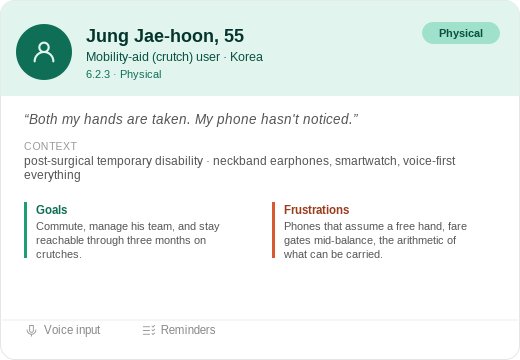
정재훈 · Jung Jae-hoon
Mobility-aid (crutch) user
Korea · East Asia (Korea) · Age 55
- Law
- 장차법 · KWCAG 2.2
- Services
- 정부24 / 카카오·토스
- Messaging
- KakaoTalk
Assistive Technology
- Voice input
- Reminders
Both my hands are taken. My phone hasn't noticed.
Goals
Commute, manage his team, and stay reachable through three months on crutches.
Frustrations
Phones that assume a free hand, fare gates mid-balance, the arithmetic of what can be carried.
Profile
Jeong Jae-hun is a mid-level manager who has been on crutches for three months after hip surgery. Because both hands must hold the crutches, using a device while moving is very limited. The disability is temporary, but he is feeling firsthand how important digital accessibility is.
Technology Environment
- Hands-free: neckband earphones, voice assistant
- Stands: desk phone holder, tablet stand
- Wearable: a smartwatch for basic control
- Voice commands: calls, messages, navigation
Daily Scenario
On the morning commute, Jae-hun heads to the bus stop on crutches. He wants to check arrival times but can't get his phone out of his pocket. Even checking the smartwatch is unstable, since he has to lean a crutch to one side.
"Hey Siri, when's the 341 bus?" He asks by voice, and the earphones reply: "Arriving in 3 minutes." Boarding, he carefully gathers both crutches into one hand and balances to tap his transit card.
// Jae-hun's hands-free digital-life setup
const handsFreeLiving = {
  voiceAssistant: {
    wakeWord: 'always_listening',
    shortcuts: {
      'commute': ['tell me the weather', "today's schedule", 'when is the 341 bus'],
      'meeting': ['guide me to the room', "text attendees I'm 5 minutes late", 'open the meeting file']
    },
    autoResponses: {
      incomingCall: "I'm on the move right now and can't take the call. I'll get back to you shortly.",
      walkingMode: true
    }
  },
  smartWatch: {
    complications: ['next_appointment', 'weather', 'bus_arrival', 'step_counter'],
    quickActions: { singleTap: 'show_notifications', doubleTap: 'voice_command', longPress: 'emergency_call' },
    fallDetection: { enabled: true, sensitivity: 'high', emergencyContacts: ['wife', 'son'] }
  },
  automation: {
    location_based: {
      arriving_office: ['disable_do_not_disturb', 'connect_to_office_wifi', 'open_calendar'],
      leaving_office: ['send_location_to_family', 'check_weather', 'traffic_alert']
    },
    time_based: { medication_reminder: '09:00, 14:00, 20:00', rest_reminder: 'every_2_hours' }
  }
};
At the office, Jae-hun stands at a standing desk. Sitting and rising is hard, so he mostly works on his feet. He leans the crutches on the desk and wakes the computer by voice: "Unlock computer, open email."
After lunch he has to book a clinic appointment. Operating the hospital app on his phone is hard, so he places a tablet on a stand and uses it—slowly selecting the date with one finger on the big screen and completing the booking.
Challenges & Strategies
- Keeping balance: freeing even one hand makes his posture unstable. Jae-hun only operates devices near a wall or a stable support.
- Can't respond instantly: he can't answer calls or messages right away. He sets auto-replies and confirms important contacts by voice.
- Carrying things: he can't hold a bag or documents. He uses a backpack and relies on digital documents as much as possible.
Design Implications
- Voice-first: every function controllable by voice.
- Wearable integration: access key functions from the smartwatch.
- Stronger automation: context-aware automatic actions.
- Safety features: fall detection and emergency calling within easy reach.