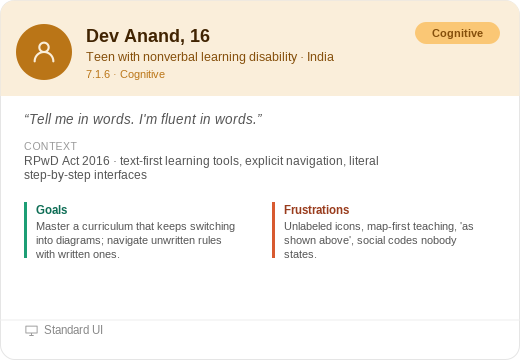
Dev Anand
Teen with nonverbal learning disability
India · South Asia · Age 16
- Law
- RPwD Act 2016
- Services
- Aadhaar / UMANG / UPI
- Messaging
Assistive Technology
- Standard UI
Tell me in words. I'm fluent in words.
Goals
Master a curriculum that keeps switching into diagrams; navigate unwritten rules with written ones.
Frustrations
Unlabeled icons, map-first teaching, 'as shown above', social codes nobody states.
Profile
Dev Anand is a high-school sophomore with a nonverbal learning disability (NVLD). His verbal skills are strong, but visuospatial processing, pattern recognition, and reading social cues are hard. He prefers concrete, explicit explanation over abstract concepts and is strongest in text-based learning.
Technology Environment
- Learning: text-centric apps, explicit instructions
- Navigation: detailed turn-by-turn, landmark-based
- Communication: prefers text over emoji
- Scheduling: calendars with specific times and places
Daily Scenario
Wednesday afternoon, Dev does an online math assignment. He struggles to understand the 3D shapes in a geometry problem. Fortunately the learning platform offers an option that explains each step in detail with text: "Every face of a cube is a square. A square is a quadrilateral with four equal sides."
<!-- Dev's preferred explicit interface -->
<div class="nvld-friendly-interface">
  <header>
    <h1>Math assignment - 3D shapes</h1>
    <p class="explicit-location">You are here: Home > Math > Year 3 > Geometry > 3D shapes</p>
  </header>

  <nav class="text-based-navigation">
    <ul>
      <li><a href="#" class="current">1. Cube (current page)</a></li>
      <li><a href="#">2. Cuboid (next page)</a></li>
      <li><a href="#">3. Sphere (in two pages)</a></li>
    </ul>
  </nav>

  <main class="content">
    <section class="instructions">
      <h2>How to study</h2>
      <ol class="explicit-steps">
        <li>Read the explanation below slowly</li>
        <li>Write down anything you don't understand</li>
        <li>Work through the examples one at a time</li>
        <li>Check your answers and read the worked solution</li>
      </ol>
    </section>

    <section class="content-area">
      <h3>What is a cube?</h3>
      <p class="definition">A cube is a 3D shape made of 6 faces. Every face is a square and every edge is the same length.</p>

      <h4>Properties of a cube (described in words)</h4>
      <ul>
        <li>Faces: 6 (top, bottom, front, back, left, right)</li>
        <li>Edges: 12</li>
        <li>Vertices: 8</li>
        <li>If one edge has length a:
          <ul>
            <li>Area of one face = a × a</li>
            <li>Total surface area = 6 × a × a</li>
            <li>Volume = a × a × a</li>
          </ul>
        </li>
      </ul>
    </section>
  </main>

  <footer class="action-buttons">
    <button type="button" class="explicit-action">Go back to the previous page</button>
    <button type="button" class="explicit-action primary">Go to the next page (learn the cuboid)</button>
  </footer>
</div>
In an online group chat with friends, Dev often misses the conversational context. When a friend writes "lol omg," it's hard to tell whether it's genuinely funny or sarcastic. For important exchanges, Dev asks plainly in a private message: "Was that a joke just now, or were you serious?"
He uses special settings for navigation too, preferring a list-style, detailed route over a bird's-eye map. Instead of "turn right at the big intersection," he needs concrete guidance like "at the intersection with the convenience store, turn 90 degrees to the right."
Challenges & Strategies
- Understanding metaphor and implication: he takes icons, gestures, and figurative expressions literally. Dev asks for explicit labels and explanations.
- Processing spatial information: maps, graphs, and diagrams are hard to interpret. He prefers text descriptions or tabular data.
- Reading social context: online tone, mood, and unspoken rules are hard to grasp. He prefers environments with clear communication rules.
Design Implications
- Explicit labeling: provide a text label and explanation for every element.
- Linear structure: prefer sequential organization over complex spatial layouts.
- Concrete instructions: step-by-step clarity instead of abstract expressions.
- Text-first: supplement or replace visual elements with text.