이로운 · Lee Ro-un
Autistic child using AAC
Korea · East Asia (Korea) · Age 9
- Law
- 장차법 · KWCAG 2.2
- Services
- 정부24 / 카카오·토스
- Messaging
- KakaoTalk
Assistive Technology
- Touch / AAC
- Reminders
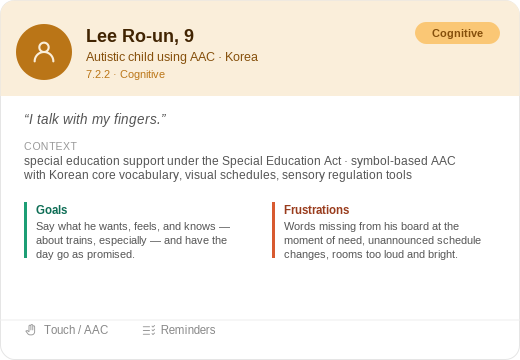
I talk with my fingers.
Goals
Say what he wants, feels, and knows — about trains, especially — and have the day go as promised.
Frustrations
Words missing from his board at the moment of need, unannounced schedule changes, rooms too loud and bright.
Profile
Lee Ro-un is a third-grade elementary student with nonverbal autism spectrum disorder. He doesn't express himself with speech, but communicates actively through a picture-symbol-based AAC device. He feels secure with regular routines and a predictable environment and shows deep interest in particular topics (trains, numbers).
Technology Environment
- AAC system: Proloquo2Go, personalized vocabulary board
- Scheduling: visual schedule, timer app
- Learning: pattern games, number apps
- Sensory control: white-noise app, adjustable visual stimulation
Daily Scenario
Thursday at 7:30 a.m., as soon as Ro-un wakes he checks the visual schedule on the wall. The day is laid out in order with picture cards: 🦷 brush teeth → 🥣 breakfast → 🎒 school → 🏠 home → 🎮 game time.
Over breakfast, Ro-un suddenly wants to say something. He opens the AAC tablet and taps the pictures in order: "I" → "want" → "juice" → "orange." The device speaks: "I want orange juice."
# Ro-un's AAC system configuration
class AACSystem:
    def __init__(self):
        self.vocabulary_organization = {
            'core_words': {'high_frequency': ['I', 'want', "don't want", 'more', 'finished'],
                           'quick_access': True, 'always_visible': True},
            'categories': {
                'food': {'subcategories': ['drinks', 'fruit', 'meals', 'snacks'], 'favorite_items': 'highlighted'},
                'feelings': {'emotion_scale': True, 'body_sensations': True, 'regulation_strategies': True},
                'activities': {'special_interests': ['trains', 'numbers']}
            }
        }
        self.communication_features = {
            'sentence_strip': {'visual': True, 'grammatical_color_coding': True, 'word_order_support': True},
            'prediction': {'based_on_context': True, 'time_of_day': True, 'location_aware': False},  # avoid too much change
            'output_options': {'voice': 'child_voice', 'text_display': True, 'symbol_size': 'large'}
        }

    def handle_communication_breakdown(self):
        """Strategy when communication breaks down."""
        return {'visual_choice_board': True, 'yes_no_questions': True, 'wait_time': 'extended', 'anxiety_support': 'calming_visuals'}
At school there's a sudden schedule change—PE swapped for music. Ro-un grows anxious. His teacher edits the visual schedule on his tablet and explains with 'first/then' cards. Showing "PE is later, music is first" gradually calms him.
Home again, Ro-un wants to watch his favorite train videos. On the AAC he selects "I" → "want to watch" → "Thomas the Train" → "YouTube." His parents open YouTube but set a 20-minute timer; when it ends, a visual 'finished' signal appears.
Challenges & Strategies
- Communication frustration: he's frustrated when he can't find the word he wants. Ro-un adds frequent words to favorites, and his parents prepare vocabulary for new situations in advance.
- Resistance to change: unexpected change makes him extremely anxious. 'First/then' boards and visual timers make change predictable.
- Sensory overload: he's overwhelmed in loud or busy environments. Ro-un wears noise-cancelling headphones and sunglasses and uses a 'break card' to move to a quiet space.
Design Implications
- Consistent layout: never move the position of buttons and menus.
- Visual structure: clear categories and a visual hierarchy.
- Predictability: show what will happen next in advance.
- Personalization: tailor to the individual's interests and routines.