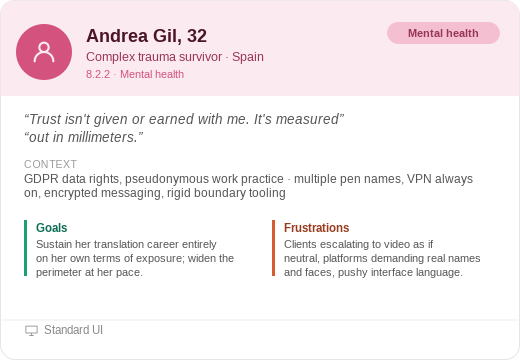
Andrea Gil
Complex trauma survivor
Spain · Europe · Age 32
- Law
- RD 1112/2018 · EAA
- Services
- Cl@ve
- Messaging
Assistive Technology
- Standard UI
Trust isn't given or earned with me. It's measured out in millimeters.
Goals
Sustain her translation career entirely on her own terms of exposure; widen the perimeter at her pace.
Frustrations
Clients escalating to video as if neutral, platforms demanding real names and faces, pushy interface language.
Profile
Andrea Gil is a complex-trauma survivor who endured prolonged emotional and physical abuse from childhood. She lives with extreme distrust of relationships, difficulty regulating emotion, and dissociative symptoms. Working as a freelance translator, she minimizes face-to-face contact and acts extremely cautiously online too.
Technology Environment
- Anonymity tools: multiple pseudonymous accounts, VPN always on
- Privacy: all location services blocked, encrypted messengers
- Security: two-factor authentication, refuses biometrics
- Boundaries: strict blocklists, private profiles
Daily Scenario
Tuesday morning, Andrea exchanges emails with a client for a new translation project. When the client proposes, "How about a video meeting?", anxiety immediately washes over her.
She politely declines: "Sorry, given my schedule, email communication will be more efficient." Showing her face and letting her voice be heard both feel like exposing herself too much, and that frightens her.
# Andrea's online-safety strategy
class ComplexTraumaSafety:
    def online_interaction_rules(self):
        return {
            'personal_info': {'real_name': 'never', 'location': 'vpn_masked', 'photos': 'no_personal_images', 'voice': 'text_only_communication'},
            'relationship_management': {
                'new_contacts': 'extensive_vetting',
                'trust_building': 'very_slow_process',
                'red_flags': ['excessive requests for personal info', 'attempts to build intimacy fast', 'ignoring boundaries', 'manipulative language'],
                'exit_strategy': 'immediate_block_and_delete'
            },
            'emotional_safety': {'triggers': 'authority_figures_aggressive_language', 'grounding_tools': '5-4-3-2-1_technique_app', 'support': 'anonymous_survivor_forums', 'emergency': 'crisis_hotline_on_speed_dial'}
        }

    def dissociation_management(self):
        return {'warning_signs': 'screen_looks_blurry', 'grounding_apps': 'sensory_focus_reminders', 'time_limits': '25min_work_5min_break', 'reality_checks': 'confirm_time_date_location'}
At lunch, Andrea checks an online support group for complex-trauma survivors. Only in this fully anonymous space can she express her true feelings. She leaves a heart emoji on someone's post, "Survived another day," resonating with it.
During afternoon work, the text she's translating contains content about child abuse. Suddenly her body freezes and a dissociative loss of reality begins. Andrea immediately runs a grounding app, following "five things you can see, four things you can hear…" to return to the present.
In the evening, checking social media, she finds a friend request from a high-school classmate. Afraid of connecting with someone who knows her past, she declines and switches her account to private, deciding to take a few days off social media.
Challenges & Strategies
- Difficulty building trust: she finds it hard to trust anyone even online, leading to isolation. Andrea builds selective trust very slowly.
- Extreme boundary-setting: overly strict boundaries sometimes cost her opportunities. She tries a little flexibility within the range she feels safe.
- Dissociation: exposure to triggering content makes her lose touch with reality. She breaks work into short blocks and practices grounding often.
- Emotion regulation: she reacts extremely even to small rejections or criticism. She makes emotion-regulation apps and breathing practice part of her daily routine.
Design Implications
- Gradual trust-building: let the user control disclosure at their own pace.
- Clear boundary tools: fine-grained control over blocking, restricting, and filtering.
- Trauma-sensitive language: use gentle, non-threatening wording.
- Dissociation response: integrate grounding tools that aid reality awareness.