Tanvir Ahmed
Heart condition, limited mobility
Bangladesh · South Asia · Age 75
- Law
- Rights & Protection of PWD Act 2013
- Services
- bKash / MyGov BD
- Messaging
- WhatsApp · imo
Assistive Technology
- Captions
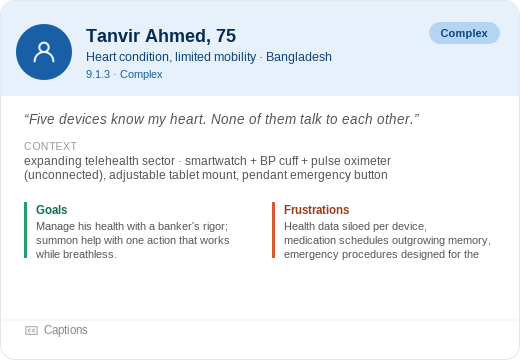
Five devices know my heart. None of them talk to each other.
Goals
Manage his health with a banker's rigor; summon help with one action that works while breathless.
Frustrations
Health data siloed per device, medication schedules outgrowing memory, emergency procedures designed for the calm.
Profile
Tanvir Ahmed has heart failure that limits daily activity and knee arthritis that makes walking hard. A former bank branch manager, he wants systematic health management, but data doesn't sync across his various health apps and devices, which is inconvenient. Being able to ask for help when urgent is his biggest concern.
Technology Environment
- Health monitoring: smartwatch, blood-pressure monitor, pulse oximeter
- Tablet: adjustable stand usable from bed/chair
- Emergency call: pendant emergency button, voice-recognition speaker
- Telemedicine: video-consultation app (still learning)
Daily Scenario
At 5 a.m., Tanvir wakes with chest tightness. He tries to check his smartwatch, but in the dark room the small numbers are hard to read. He turns on the bedside tablet to check his heart rate, but the smartwatch data doesn't auto-sync with the tablet app, so he has to enter it manually.
// The integrated health-management system Tanvir wants
const integratedHealthSystem = {
  devices: {
    smartwatch: { metrics: ['heart rate', 'ECG', 'activity'], alerts: { heartRate: { min: 50, max: 100 }, irregularRhythm: true } },
    bloodPressure: { schedule: ['07:00', '19:00'], autoSync: true },
    oxygenSaturation: { continuousMonitoring: true, alertThreshold: 92 }
  },
  emergencyProtocol: {
    triggers: ['heartRate > 120 sustained', 'oxygenLevel < 90', 'voice command: "help me"', 'fall detected'],
    actions: ['auto-alert family', 'send location', 'prepare auto-connect to emergency services']
  },
  display: { fontSize: 'extra-large', contrast: 'high', criticalInfo: 'always-visible', language: 'simple' }
};
At his morning medication time, Tanvir struggles to remember the timing and dosage of seven medicines. He uses a medication app, but registering a photo of each pill and setting alerts is too complex. In the end he takes his medicine by reading a handwritten note in a notebook.
When his video-consultation time arrives, he can't recall how to open the app. Clicking the link in the text takes him to the app store, and it takes ages to find the already-installed app. He finally connects, but although he can see the doctor's face, he can't hear the voice—only later realizing he'd accidentally pressed mute.
Challenges & Strategies
- Physical limits and emergencies: when short of breath or in chest pain, he can't perform complex operations. Tanvir wants a system that connects him to family and emergency services with just the voice command "help me."
- Managing multiple devices: each health device works independently, making an overall picture of his health hard. He wishes he could see all data on one screen.
- Cognitive burden: remembering how to use several apps, his medication schedule, and appointments is overwhelming. He wants to manage everything through one simple interface.
Design Implications
- One-button emergency call: request help instantly without a complex process.
- Automatic data integration: auto-collect and display information from all devices.
- Context awareness: auto-show the functions needed at each time of day.
- Prepared for impairment situations: varied input methods—voice, gesture, touch.