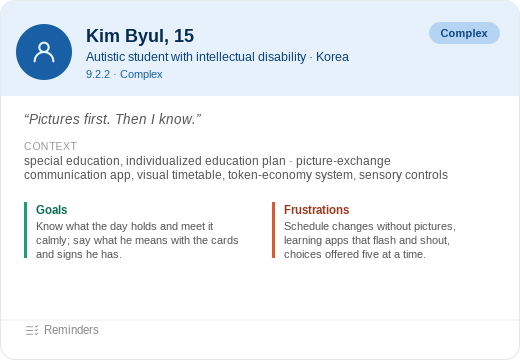
김별 · Kim Byul
Autistic student with intellectual disability
Korea · East Asia (Korea) · Age 15
- Law
- 장차법 · KWCAG 2.2
- Services
- 정부24 / 카카오·토스
- Messaging
- KakaoTalk
Assistive Technology
- Reminders
Pictures first. Then I know.
Goals
Know what the day holds and meet it calmly; say what he means with the cards and signs he has.
Frustrations
Schedule changes without pictures, learning apps that flash and shout, choices offered five at a time.
Profile
Kim Byeol is a middle-school student with both autism spectrum disorder and a mild intellectual disability. Verbal expression is limited and she prefers a predictable routine, feeling anxious at sudden change. Strong in visual learning, she mainly communicates through pictures and photos. She receives individualized education at a special school and is improving her learning and communication through digital tools.
Technology Environment
- Communication: PECS (picture exchange communication) app
- Learning: visual schedule, token-economy app
- Sensory control: noise-cancelling headphones, brightness-adjustable screen
- Safety: GPS tracker, caregiver-alert system
Daily Scenario
At 8:30 a.m., Byeol arrives in class and checks the visual schedule on her tablet. The day's tasks are shown in pictures, in order; the first is a 'Korean class' picture. Reassured, Byeol takes her seat.
In Korean class, the teacher reads a storybook. On her tablet, Byeol views an interactive version of the same story—touching the screen makes characters move and plays sound effects. But too much animation overstimulates her and she begins to feel anxious.
# Adaptive learning interface for Byeol
class AutismFriendlyLearning:
    def __init__(self, user_profile):
        self.sensory_preferences = {
            'visual_complexity': 'low', 'animation': 'minimal', 'sound_effects': 'optional',
            'color_scheme': 'muted', 'transition_speed': 'slow'
        }
        self.communication_support = {
            'primary_mode': 'visual', 'vocabulary_level': 'core_words',
            'choice_options': 2,            # limit choices to 2
            'response_time': 'unlimited'
        }

    def daily_schedule(self):
        return [
            {'time': '09:00', 'activity': '📚', 'label': 'Korean'},
            {'time': '10:00', 'activity': '🔢', 'label': 'Math'},
            {'time': '11:00', 'activity': '🍎', 'label': 'Snack'},
            {'time': '11:30', 'activity': '🎨', 'label': 'Art'}
        ]

    def adaptive_content(self, lesson):
        # Adjust content to the student's current state
        if self.detect_overstimulation():
            lesson.reduce_complexity(); lesson.remove_animations(); lesson.dim_screen(20)
        if self.detect_frustration():
            lesson.provide_break_option(); lesson.simplify_choices()
        return lesson
At lunch, Byeol finds it hard to choose from the meal menu. The teacher helps by showing two menu photos on the tablet for her to pick. When Byeol touches the kimchi-stew photo, the app outputs the voice, "Kimchi stew, please."
In afternoon free time, Byeol plays her favorite car-puzzle app. She loves repeating the same puzzle. The app learns her preference and offers only car puzzles of similar difficulty. Each time she finishes, a short celebration animation plays.
Challenges & Strategies
- Limited communication: she struggles with how to convey what's hard to say in words. Byeol practices combining picture cards to express more complex intentions.
- Sensory overload: ordinary educational content is too stimulating. Byeol's teacher reviews and modifies all content in advance.
- Rigid thinking: fixated on one way, she rejects other methods. The teacher introduces new things very slowly, in stages.
Design Implications
- Extreme simplicity: one clear purpose per screen.
- Consistency: absolute consistency of button position, color, and behavior.
- Sensory control: options letting the user adjust stimulation level.
- Failure-free environment: every choice accepted with positive feedback.