조승연 · Cho Seung-yeon
Researcher with ME/CFS
Korea · East Asia (Korea) · Age 39
- Law
- 장차법 · KWCAG 2.2
- Services
- 정부24 / 카카오·토스
- Messaging
- KakaoTalk
Assistive Technology
- Standard UI
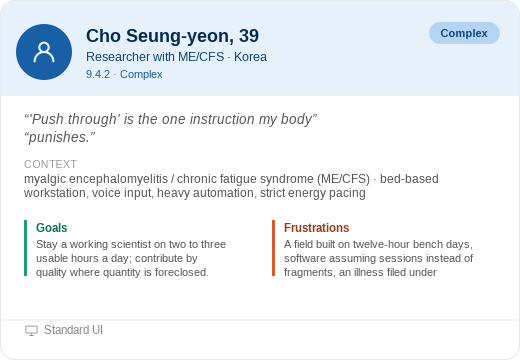
'Push through' is the one instruction my body punishes.
Goals
Stay a working scientist on two to three usable hours a day; contribute by quality where quantity is foreclosed.
Frustrations
A field built on twelve-hour bench days, software assuming sessions instead of fragments, an illness filed under 'tired'.
Profile
Cho Seung-yeon is a biology researcher living with ME/CFS (myalgic encephalomyelitis / chronic fatigue syndrome). After failing to recover from a cold, she has had severe fatigue, muscle pain, and cognitive impairment for three years. She once immersed herself in research 12 hours a day; now she can work only 2–3 hours. She has built an environment to work lying down and continues her research while conserving energy to the extreme.
Technology Environment
- Bed workspace: adjustable bed, laptop stand
- Voice control: speech-recognition software to minimize typing
- Automation: repetitive-task scripts, AI research assistant
- Collaboration: asynchronous communication, recorded presentations
Daily Scenario
At 10 a.m., Seung-yeon opens her eyes in bed. Even sitting up is as hard as climbing Everest. Her heart-rate monitor reads 95 bpm at rest—today is a bad day.
Lying down, she holds a tablet and checks email. A collaborator has sent data-analysis results. She wants to read it closely, but her brain feels fogged. She records just a brief first impression as a voice memo.
// Seung-yeon's ME/CFS energy-management system
const mecfsEnergyManagement = {
  pacing: {
    activityLevels: { rest: 0, minimal: 1, light: 2, moderate: 3, crash_zone: 4 },  // minimal=email, moderate=video call, crash_zone=avoid entirely
    dailyBudget: { total_points: 6, allocation: { morning: 3, afternoon: 2, evening: 1 } },  // morning when cognition is best
    crashPrevention: {
      warning_signs: ['heart_rate > 100', 'word_finding_difficulty', 'muscle_tremors'],
      immediate_response: 'stop_all_activity',
      recovery_protocol: 'complete_rest_24h_minimum'
    }
  },
  workAdaptations: {
    microTasks: { max_duration: '15_minutes', rest_between: '45_minutes', task_chunking: 'extreme_granularity' },
    cognitiveAids: { ai_summarization: 'reduce_reading_load', voice_to_text: 'conserve_physical_energy', automation: 'eliminate_repetitive_tasks', templates: 'minimize_decision_fatigue' }
  },
  crashManagement: {
    triggers: ['overexertion', 'stress', 'infections', 'sensory_overload'],
    symptoms: ['post_exertional_malaise', 'orthostatic_intolerance', 'cognitive_dysfunction'],
    recovery: { duration: '48h_to_weeks', activities: 'absolute_minimum', support: 'prepared_meals_medication_within_reach' }
  }
};
At 2 p.m., Seung-yeon analyzes data for 15 minutes and is exhausted; her heart rate has risen to 110. She immediately stops all activity and closes her eyes, regulating her breathing by following a meditation app.
At 6 p.m., a little recovered, she prepares for tomorrow's research meeting. Attending in person is impossible, so she pre-records a 5-minute presentation video. Recording it in one take is too hard, so she films a minute at a time and edits them together.
Challenges & Strategies
- Severe activity limits: even slight overexertion leaves her unable to get up for days. Seung-yeon copes through rigorous energy management and prioritization.
- An unrecognized illness: many mistake it for simple tiredness. She shares trustworthy medical materials to ask for understanding.
- Career-disruption risk: full-time work is impossible. She has shifted to freelance research, contributing through quality over quantity.
Design Implications
- Extreme energy efficiency: minimize every interaction.
- Easy stop-and-resume: pause anytime and continue later.
- Distribute cognitive load: split complex work into very small units.
- Maximize automation: eliminate repetitive, unnecessary tasks.