Alex Reyes
Living with lupus
USA · North America · Age 29
- Law
- ADA · Section 508
- Services
- Login.gov / state portals
- Messaging
- iMessage · WhatsApp
Assistive Technology
- Standard UI
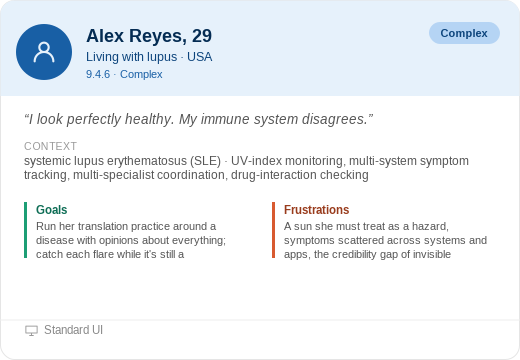
I look perfectly healthy. My immune system disagrees.
Goals
Run her translation practice around a disease with opinions about everything; catch each flare while it's still a warning.
Frustrations
A sun she must treat as a hazard, symptoms scattered across systems and apps, the credibility gap of invisible illness.
Profile
Alex Reyes is a freelance translator living with systemic lupus erythematosus (SLE). An autoimmune disease, lupus affects the whole body—skin, joints, kidneys, brain. Alex is extremely sensitive to ultraviolet light and repeatedly experiences fatigue, joint pain, and fever. Looking healthy on the outside, Alex is in fact fighting a complex set of symptoms.
Technology Environment
- Environmental monitoring: UV-index app, indoor-environment sensors
- Health tracking: multi-symptom logging, lab-result management
- Work tools: blue-light blocking, voice recognition
- Medical: multidisciplinary-care coordination, drug-interaction checks
Daily Scenario
At 7 a.m., Alex assesses joint stiffness for the day. The fingers are swollen and hard to bend—a high-lupus-activity period, it seems. Wondering whether to adjust the steroid dose, Alex logs it in a symptom-tracking app.
Opening the curtain slightly to look outside, it's sunny—but for Alex that's dangerous. The UV-index app reads 'very high.' Alex decides to stay home today and applies sunscreen even indoors.
// Alex's integrated lupus-management system
const lupusManagementSystem = {
  environmentalProtection: {
    uvMonitoring: { outdoor: 'real_time_uv_index', indoor: 'window_film_uv_blocking', clothing: 'upf_50_plus', alerts: 'high_uv_day_warnings' },
    temperatureControl: { optimal_range: '20-22C', humidity: '40-50%', air_quality: 'hepa_filtered' }
  },
  symptomComplexity: {
    tracking: { joint_pain: 'location_intensity_map', fatigue: 'energy_units_remaining', rashes: 'photo_documentation', fever: 'continuous_monitoring', cognitive: 'brain_fog_assessment' },
    patterns: { flare_triggers: ['stress', 'infection', 'uv_exposure', 'overexertion'], warning_signs: ['butterfly_rash', 'joint_swelling', 'protein_in_urine'], intervention_points: 'early_medication_adjustment' }
  },
  workAdaptations: {
    flexibility: { hours: 'completely_flexible', deadlines: 'buffer_for_flares', workload: 'scalable_based_on_health' },
    cognitiveSupport: { brain_fog_days: { tools: ['ai_translation_assist', 'grammar_check', 'consistency_check'], strategies: ['shorter_sessions', 'detailed_notes', 'double_checking'] } }
  }
};
At 2 p.m., mid-translation, a word suddenly won't come—'lupus fog' has set in. Expressions that usually come easily vanish from Alex's mind. Alex turns on an AI translation-assist tool and works by taking its suggestions.
At 6 p.m., Alex has an online consultation. Rheumatology, nephrology, and dermatology all need visiting, but with lupus-weakened immunity, hospital visits are a burden. Via video, Alex reviews lab results and discusses medication adjustments.
At 9 p.m., Alex joins an online lupus patient group. Sharing a photo with "My butterfly rash got worse today," other patients offer management tips. Alex takes comfort in not being alone.
Challenges & Strategies
- Multi-system symptoms: problems arise in several organs at once. Alex identifies patterns with an integrated symptom-management system.
- Invisible seriousness: apart from a facial rash, little shows outwardly. Alex keeps a medical explanation ready when needed.
- Unpredictable course: it repeatedly improves and worsens. Alex copes with flexible scheduling and backup plans.
Design Implications
- Multi-tracking system: grasp the correlations among complex symptoms.
- Environmental integration: link digital devices with environmental sensors.
- AI assistance: support work during cognitive decline.
- Telemedicine optimization: efficient coordination of multidisciplinary care.